
For decades, many industrial distributors have relied on one thing that has always worked—relationships.
A phone call.
A trusted sales representative.
A long-standing customer.
A purchase order sent over email or WhatsApp.
For over 30 years, one of our clients in the MRO (Maintenance, Repair & Operations) industry had built a successful business using exactly this model.
They had loyal customers.
Experienced salespeople.
Strong supplier relationships.
Yet they faced a challenge that almost every traditional industrial business encounters today.
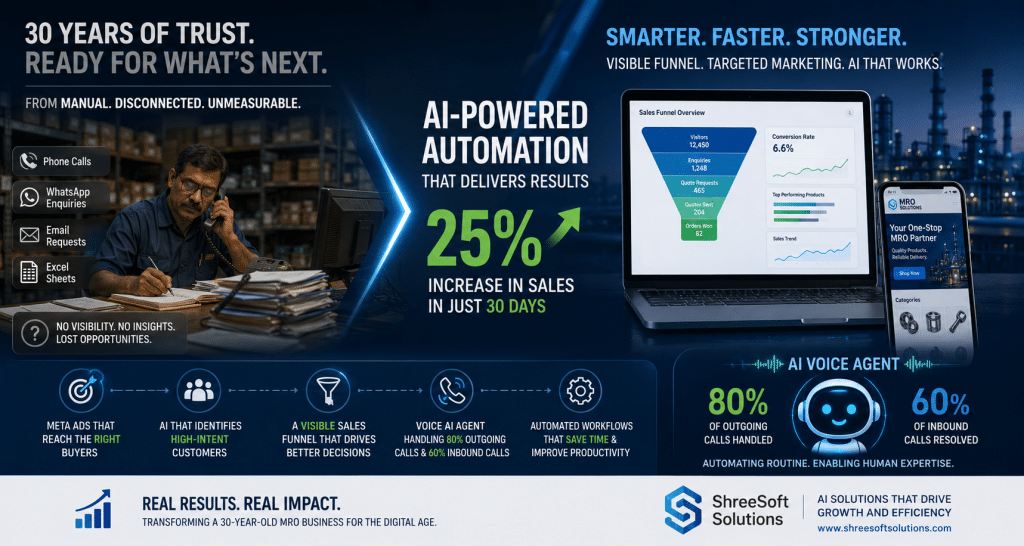
They had no visibility into how sales actually happened.
The Hidden Cost of an Offline Sales Model
When we began working with the client, the business generated a healthy volume of enquiries every month.
However, no one could accurately answer questions such as:
- Which marketing activities generated leads?
- How many enquiries converted into quotations?
- Which quotations became purchase orders?
- Why were customers dropping off?
- Which products attracted the most attention?
- Which salesperson converted the highest-value opportunities?
Everything lived across multiple channels:
- Phone calls
- WhatsApp conversations
- Emails
- Excel sheets
- Individual salesperson knowledge
Management could see revenue.
They could not see the journey that created it.
Without visibility, improving sales became guesswork.
Step 1: Making the Sales Funnel Visible
The first objective wasn't automation.
It was visibility.
We designed a digital sales funnel that connected every customer interaction into a measurable journey.
Instead of simply tracking revenue, management could now see:
- Website visitors
- Product page engagement
- Lead enquiries
- Quote requests
- Follow-up stages
- Purchase orders
- Repeat customers
For the first time in three decades, sales stopped being a black box.
It became measurable.
More importantly, every leakage point became visible.
Step 2: Revamping the E-Commerce Experience
The company's website had existed for years but functioned more like an online brochure.
Customers could browse.
They couldn't easily buy.
The new platform focused on reducing friction.
Key improvements included:
- Faster product discovery
- Better search functionality
- Category-based navigation
- Mobile optimisation
- Clear enquiry and quotation workflows
- Product availability visibility
- Better technical specifications
- Simplified checkout for eligible products
Instead of replacing the traditional sales process, the website complemented it.
Customers could now choose whether to buy online or continue engaging with the sales team.
Step 3: Using AI to Understand Customer Behaviour
One of the biggest advantages of AI isn't replacing people.
It's recognising patterns humans simply don't have time to analyse.
The system continuously monitored:
- High-interest products
- Frequently abandoned enquiries
- Returning visitors
- Buying intent signals
- Customer segments
- Seasonal demand
- Marketing campaign performance
Sales teams no longer spent time deciding who to call first.
AI prioritised the highest-probability opportunities.
The result?
Faster response times.
Higher conversion rates.
Better utilisation of the sales team's expertise.
Step 4: Meta Ads That Targeted the Right Buyers
With a measurable funnel in place, paid advertising finally became accountable.
Instead of broad campaigns focused only on clicks, we structured Meta campaigns around business outcomes.
The campaigns targeted:
- Manufacturing companies
- Plant maintenance teams
- Procurement professionals
- Engineering managers
- Industrial buyers
Traffic was directed to dedicated landing pages aligned with specific product categories and buying intent.
Because every visitor could now be tracked through the sales funnel, marketing spend was no longer viewed as a cost—it became an investment with measurable performance.
Step 5: AI Voice Agents Transformed Customer Communication
Perhaps the most impactful change came from introducing AI-powered voice automation.
Like many industrial businesses, the organisation relied heavily on telephone conversations.
Sales representatives spent a large portion of their day:
- Calling vendors
- Following up on quotations
- Confirming stock
- Checking delivery schedules
- Updating customers
- Answering repetitive enquiries
These conversations were essential but highly repetitive.
AI Voice Agents took over much of this operational workload while remaining integrated with the existing business process.
Within the first month:
- Approximately 80% of outgoing routine calls were handled by the AI Voice Agent.
- Around 60% of inbound customer calls were resolved automatically without requiring human intervention.
The AI agent could:
- Confirm product availability
- Share order status
- Handle routine enquiries
- Schedule callbacks
- Route complex conversations to the right salesperson
- Collect structured customer information before transferring calls
Importantly, the goal was not to replace experienced sales professionals.
It was to free them from repetitive tasks so they could focus on higher-value activities such as relationship building, technical consultations, and closing larger opportunities.
The Outcome After 30 Days
Within the first month of implementing these initiatives, the business achieved:
- 25% increase in sales compared to the previous period
- Complete visibility across the sales funnel
- Faster lead response times
- Improved utilisation of marketing spend
- Higher quality inbound enquiries
- Better management reporting
- Increased customer engagement through the new website
- Significant reduction in manual calling effort through AI Voice Agents
While no single technology delivered these results on its own, the combination of process redesign, AI automation, targeted digital marketing, and improved customer experience created measurable business impact in a relatively short period.
The Bigger Lesson
Many traditional businesses believe AI means replacing employees.
In reality, the biggest opportunity is often much simpler.
AI helps businesses:
- Remove repetitive work.
- Make better decisions with data.
- Respond to customers faster.
- Improve marketing efficiency.
- Give management visibility they never had before.
The companies that succeed over the next decade won't necessarily be the ones with the most advanced AI.
They'll be the ones that combine decades of industry expertise with intelligent automation.
Is Your Business Still Running on Phone Calls and Spreadsheets?
If your organisation depends on manual follow-ups, fragmented customer data, or sales processes that exist only in the minds of experienced employees, AI can help modernise operations without disrupting what already works.
The first step isn't adopting every new technology.
It's understanding where visibility, automation, and better customer experiences can create the greatest impact.
That's where a structured AI assessment makes all the difference.
At ShreeSoft Solutions, we help manufacturing companies, MRO suppliers, industrial distributors, and B2B businesses identify practical AI opportunities that deliver measurable business outcomes—from AI-powered marketing and intelligent sales funnels to voice automation and cloud-native business platforms.
If you're ready to see what AI can do for your business, we'd be happy to start with an AI Readiness & Automation Assessment and map out a practical roadmap tailored to your operations.