
Most enterprise marketing systems do not fail due to a lack of features. They fail because they are built like a patchwork quilt rather than a cohesive machine.
When your customer data systems, CRM hubs, and execution platforms cannot communicate dynamically, your pipeline springs leaks. Duplicate lead tracking scripts slow down page speeds, unaligned attribution platforms skew executive ROI calculations, and manual data synchronization burns through thousands of engineering hours.
True operational excellence requires a specialized approach: structural marketing technology ecosystem design.
Why Modern MarTech Stacks Accumulate Technical Debt
Most companies buy software reactively. A marketing department faces an attribution issue, so they purchase a niche tracking tool. The sales development team needs cleaner outbound flows, so they stack on another automated email sequencer.
Within two years, the enterprise is managing dozens of underutilized user licenses, overlapping features, and siloed data buckets. This fragmentation causes real damage:
1. API Latency and Failures: Data updates slowly across systems, leading to delayed follow-ups and lost leads.
2. Compliance Risks: Mismatched privacy governance across systems makes it difficult to maintain strict data compliance regulations.
3. Opinion-Driven Decisions: Fragmented data forces executives to make decisions based on assumptions rather than concrete analytical proof.
The Pillars of a Strategic Architecture
A scalable marketing infrastructure separates your technologies into three clearly defined functional layers:
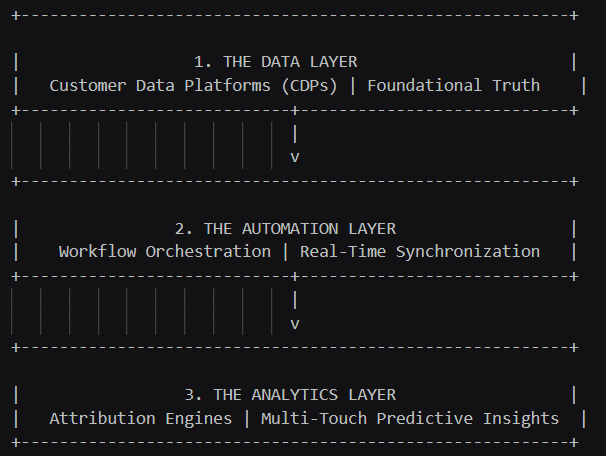
1. The Data Layer
Your data infrastructure must sit independent of your execution tools. By establishing a central Customer Data Platform (CDP) or database clean room as your underlying foundation, you create a single source of truth. Every user touchpoint, form fill, and conversion feeds into this layer first before distributing down the funnel.
2. The Automation Layer
Once clean data is established, cross-channel workflows orchestrate consumer communication. Instead of setting up basic triggers inside isolated apps, synchronization engines pass multi-touch buyer data globally. This ensures an enterprise prospect receives tailored messaging based on their actual location, account size, and platform interaction.
3. The Analytics Layer
The final layer connects downstream conversions with upstream ad spend. By deploying multi-touch attribution algorithms, marketing leaders can accurately measure individual campaign performance. This shifts your operational strategy from superficial vanity metrics into direct profitability tracking.
Step-by-Step Implementation Framework
Engineering a high-performance system is a deliberate, step-by-step technical process:
Step 1: The Stack Audit & Script Minimization
We map every single marketing tag, analytics container, and background script running across your digital ecosystem. Removing redundant tracking pixels instantly boosts site speed and prevents data inflation.
Step 2: Unified Schema Configuration
We normalize how data fields are structured across your entire organization. Whether a user interacts via an enterprise portal, a landing page, or an email link, their identifiers must match perfectly across your entire backend database.
Step 3: Zero-Latency API Engineering
We build direct, automated pipelines between your lead generation interfaces and your master CRM systems. Eliminating bulk batch uploads ensures your team can engage prospects while intent is at its peak.
Engineering Systems for Predictable Scale
Building an engineered platform changes how your organization operates. Instead of chasing loose tasks, your marketing teams focus on optimization. Systems run smoothly, tracking errors disappear, and clean operational data flows naturally to executive dashboards.
At Shreesoft Solutions, we build profit-driven growth systems that transform ambitious brands into category leaders. We leverage technology not just as an auxiliary tool, but as a core competitive advantage.
Optimize Your Digital Infrastructure
Stop letting disconnected software applications limit your business growth. Contact our enterprise architecture team today to secure a technical stack audit and design a high-performing marketing ecosystem.